Simultaneous Contrast: Balancing Large Color Field Masses
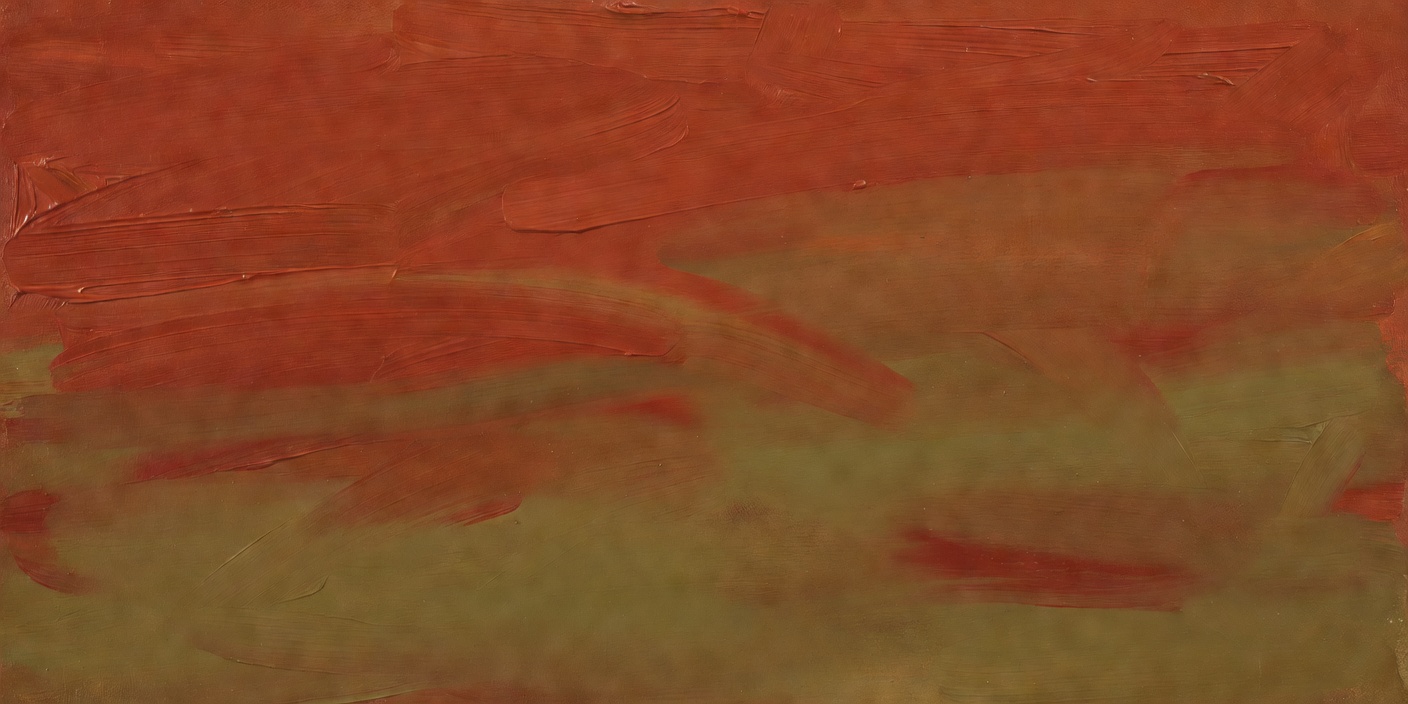
Color does not exist in isolation upon an abstract canvas; it is a relational force defined entirely by neighboring wavelengths. In monumental canvas painting, the primary challenge of the artist is managing how adjacent color fields activate, dull, or physically advance toward the spectator.
The Mechanics of Retinal Fatigue and Edge Glow
When an observer fixates on a dense area of synthetic red iron oxide (PR101), the eye’s red-sensitive photoreceptors gradually exhaust their chemical photopigments. At the peripheral frontier where this red mass meets an unsized warm cream ground, the human visual cortex compensates by producing the complementary chromatic aura. This phenomenon, formalized by chemist Michel Eugène Chevreul, is known as simultaneous contrast.
In our studio research, we manipulate this edge gradient to alter spatial illusion. A razor-sharp tape-pulled edge causes the two color masses to lock into rigid planar tension. Conversely, feathering the border with a stiff bristle brush loaded with dry marble dust softens the transition, creating an atmospheric bleed that pulls the observer into deep pictorial recess.
Thermal Weight: Warm vs. Cool Mass Proportions
Warm earth pigments—such as Venetian red, burnt sienna, and raw yellow ochre—possess greater visual weight than cool or neutral tones. In a large 200cm × 180cm linen substrate, an area of high-saturation terracotta will visually dominate even if it occupies merely 25% of the total square surface area.
| Pigment Index | Thermal Character | Visual Gravitational Weight | Optimum Mass Ratio |
|---|---|---|---|
| Venetian Red (PR101) | Aggressive Warm Earth | Heavy (Forward Projection) | 20% - 30% of Total Field |
| Terre Verte (PG23) | Passive Cool Earth | Neutral Receding | 40% - 60% of Total Field |
| Alabaster Chalk Ground | Reflective Neutral | Expansive Spatial Void | Remainder Field Buffer |
Studio Pigment Formulations for Field Paintings
To avoid surface glare that interferes with pure chromatic perception, field painters frequently formulate custom matte binders. By integrating 15% calcium carbonate powder into an acrylic dispersion medium, specular highlights are extinguished. The resulting surface absorbs ambient room light and re-emits pigment wavelength with pure, non-reflective velvety depth.