Acrylic Gels vs. Stand Oil: Controlling Mark Viscosity
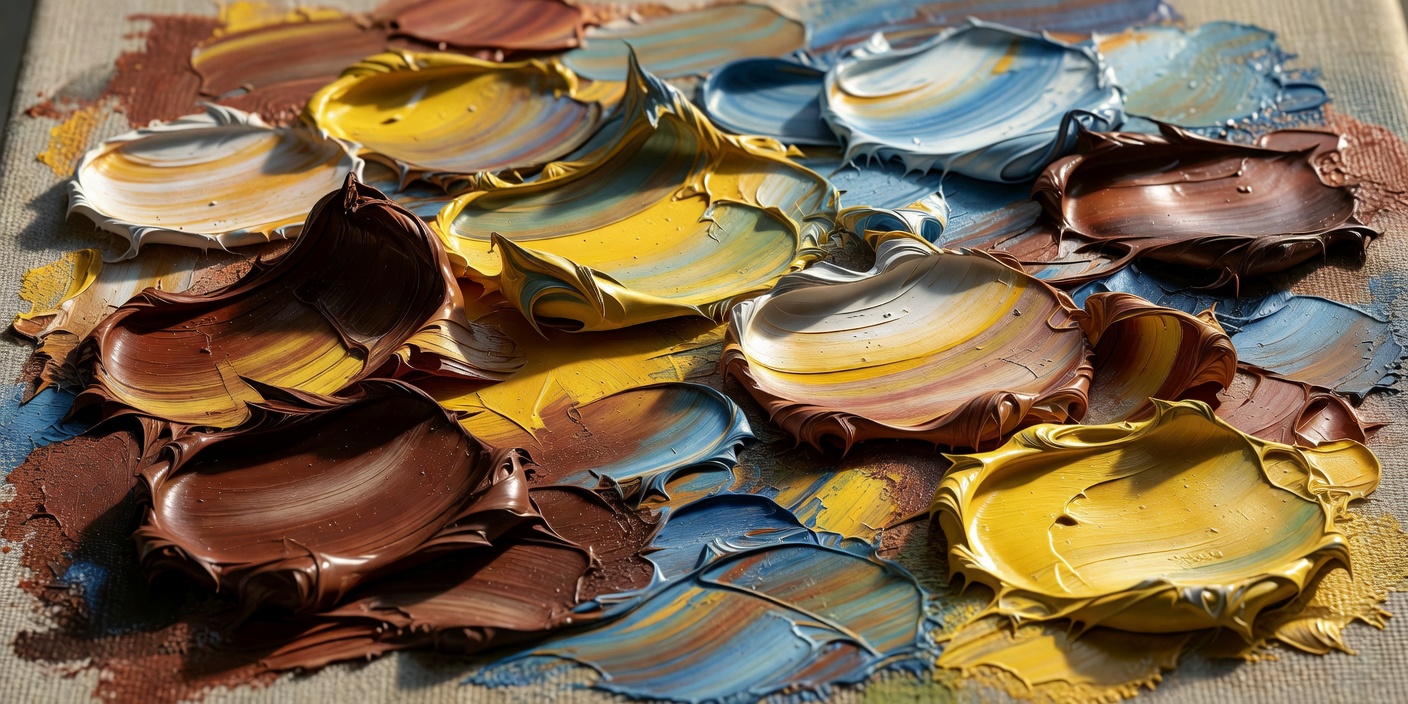
In non-representational painting, the gestural stroke carries informational content not as a symbol of an external object, but as a direct recording of force, velocity, and fluid resistance. Understanding medium rheology empowers the artist to deliberately shape whether a knife stroke leaves a razor peak or melts into an enamel-smooth glassy layer.
Acrylic Polymer Gels: Thixotropy and Instantaneous Fixation
Modern acrylic emulsions offer extreme versatility due to engineered thixotropic behavior. When at rest inside a jar or palette well, an extra-heavy gel exhibits high yield stress. However, as soon as shear stress is applied via a flexible spring-steel painting knife, internal polymer bonds release momentarily, allowing fluid spreading.
Upon lifting the tool, viscosity recovers within fractions of a second. This allows artists to construct sculptural relief structures measuring up to 25mm in elevation without sagging or slumping during evaporation-based drying.
Stand Oil and Oleoresinous Mediums: Elastic Drag
By contrast, stand oil—linseed oil polymerized by prolonged vacuum heating at 300°C—creates a radically different tactile response. Stand oil possesses long-flow rheology. When loaded onto a wide hog bristle brush, it exhibits a sticky, honey-like resistance that drags against the canvas tooth.
Rather than freezing knife ridges into jagged crystal formations, stand oil gradually levels itself over several hours, rounding sharp striations into organic undulating waves with exceptional internal luminosity.
| Medium Formula | Rheological Behavior | Peak Retention | Refractive Index |
|---|---|---|---|
| Extra-Heavy Acrylic Gel | Thixotropic (Shear-Thinning) | 100% (Sharp Rigid Edges) | 1.48 (Translucent Matte) |
| Polymerized Stand Oil | Newtonian Long Flow | 20% (Self-Leveling Glow) | 1.52 (High Gloss Depth) |
| Venice Turpentine Balsam | Resinous Tack | 50% (Sticky Enamel Trace) | 1.54 (Enamel Luster) |
| Cold Wax Paste (Beeswax) | Short Paste (Non-Elastic) | 85% (Buttery Matte Slice) | 1.44 (Diffused Satin) |
Studio Practice: Layering Without Structural Failure
When executing mixed-viscosity abstractions, painters must observe the fundamental physical rule of substrate flexibility. Heavy structural gels must be anchored onto stable, tightly stretched linen sized with non-brittle PVA grounds. Applying thick brittle oils over unpolymerized flexible gels will inevitably induce micro-fissuring and delamination as the painting cures over decades.