Resolving Tension and Negative Space in Monumental Canvases
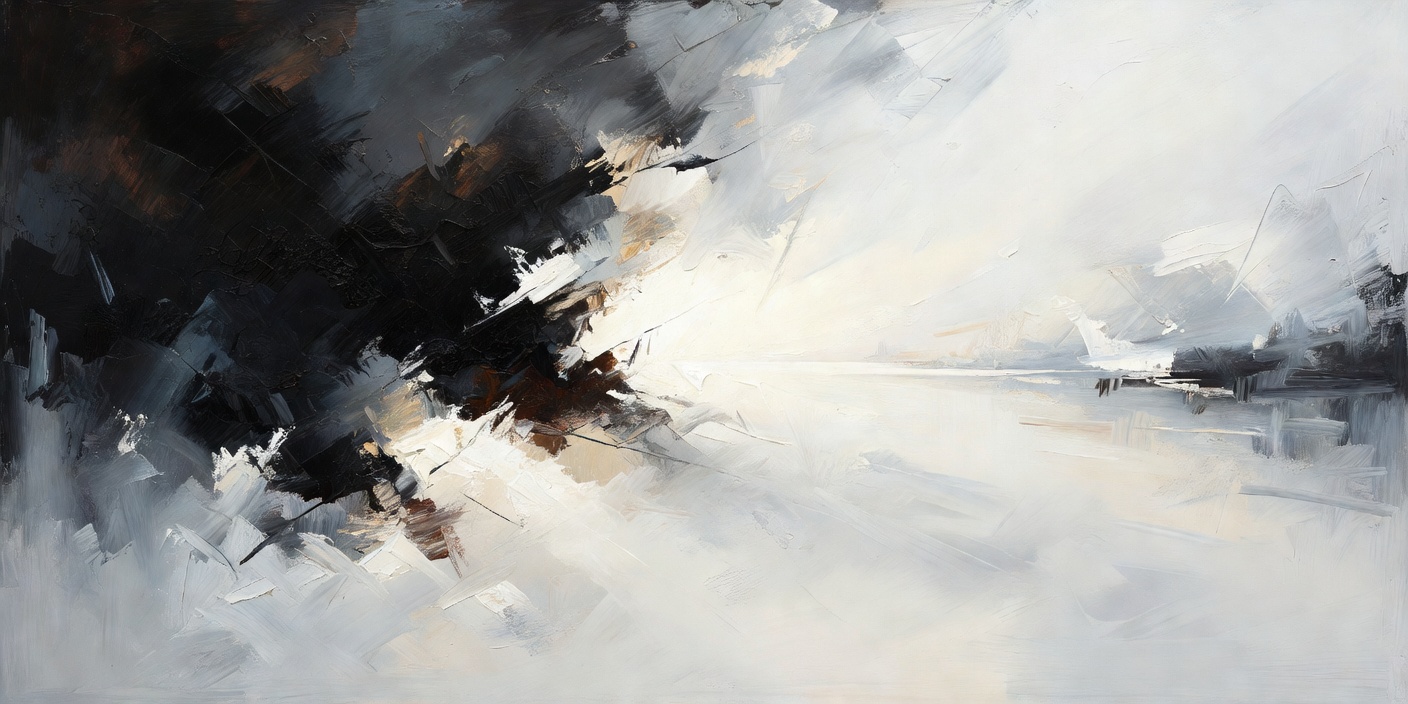
In traditional figurative painting, composition is anchored by horizon lines, vanishing points, and human anatomy. Strip those illusions away, and the canvas surface is exposed as a bare physical arena where every square decimeter exerts pressure on the whole. Spatial balance in abstraction is the intentional distribution of this visual tension.
Negative Space as an Active Structural Force
Painters frequently treat unpainted or quiet areas of a canvas as passive background. In refined non-objective abstraction, however, negative space functions as an architectural beam. An untouched raw linen void does not recede; it presses forward against neighboring colored forms, dictating their perceived scale and velocity.
When an aggressive horizontal band of terracotta terminates abruptly 5 centimeters shy of the canvas perimeter, that sliver of quiet linen absorbs the energy of the stroke like a pneumatic bumper. If the stroke had collided directly with the wood stretcher edge, the energy would bleed out into the gallery wall.
Asymmetry and the Lever Arm Principle
Equilibrium in abstract art rarely means symmetrical mirror-imaging. Symmetrical paintings quickly read as static emblems. Monumental abstraction achieves dynamic vitality through asymmetric lever mechanics.
Imagine a visual fulcrum situated at the physical geometric center of the canvas. A small, high-density, sharp-edged pigment node placed far away from the center near the upper right edge exerts an enormous rotational pull. To achieve balance without symmetry, the artist must position an expansive, diffuse, low-contrast wash of olive or cream closer to the opposite quadrant.
| Compositional Element | Optical Vector | Counterbalance Requirement |
|---|---|---|
| Sharp-edged dark impasto block | High localized focal attraction | Vast quiet field with subtle value shifts |
| Diagonal fluid pour across diagonal | Dynamic directional kinetic push | Static horizontal anchor bar near opposite base |
| Diffused wet-into-wet cloud | Atmospheric expansion / indefinite edge | High-precision linear incision or knife mark |
Architectural Scale and Peripheral Vision
Canvases exceeding two meters in breadth interact with the physical presence of the viewer’s body. When inspecting a monumental surface from a distance of two meters, the viewer’s peripheral field is consumed by the periphery of the canvas. Compositional elements placed near the outer borders pull the spectator’s head into rotational movement, transforming the static viewing experience into an unfolding physical choreography.